Quick Answer: Tilt-wall construction in Houston typically runs about $90 to $130 per square foot for a standard shell and $150 to $250 for specialized or Class A buildings. Final pricing depends on size, soil, finishes, and site work. Request a line-item estimate to price your exact building.
If you are pricing a warehouse, distribution center, or industrial facility along the Gulf Coast, tilt-wall is almost certainly on your shortlist. It is fast, durable, and built for Houston’s climate. The hard part is knowing what it actually costs before you commit capital. This guide breaks down real Houston numbers, what moves the price up or down, and how to budget without surprises.
Why Tilt-Wall Cost Matters More in Houston Than Almost Anywhere Else
Tilt-wall cost is not a national number you can copy from a calculator. Houston changes the math in ways that catch out-of-town developers off guard.
- Expansive clay soils. Much of the Houston region sits on shrink-swell clay that demands engineered foundations, pier systems, or extensive soil prep. That alone can swing your slab and foundation budget by dollars per square foot.
- Hurricane wind loads. Gulf Coast wind design requirements increase panel thickness, reinforcement, and connection detailing compared to inland markets.
- Drainage and detention. Harris County and surrounding jurisdictions require stormwater detention on most commercial sites, which adds civil work that has nothing to do with the building itself but everything to do with your total cost.
Get the cost picture wrong and you either stall the project chasing more financing or you value-engineer the wrong items and end up with a building that underperforms. Getting it right early is the entire point of a serious preconstruction estimating process.
The Real Houston Tilt-Wall Cost Ranges
Numbers vary by source because people quote different scopes. The single biggest reason owners get confused is that a panel price and a finished-building price are not the same thing. Here is how the costs actually layer.
Panels Only
The tilt-wall panel system on its own, meaning casting, crane erection, bracing, and connections, generally runs about $20 to $40 per square foot of wall area. This is the line item people see first and mistake for the building cost.
Shell Building
A standard tilt-wall shell across the Texas and Gulf Coast market commonly lands between $90 and $130 per square foot. That includes the slab, panels, structural steel, and a basic roof, ready for tenant fit-out.
Finished and Class A Facilities
Once you add office build-out, denser dock configurations, upgraded mechanical systems, climate control, and higher-grade finishes, costs climb toward $150 to $250 per square foot. Cold storage, food processing, and high-bay logistics sit at the upper end.
Larger buildings benefit from economies of scale, so a 200,000 square foot facility usually carries a lower per-foot cost than a 20,000 square foot one. This is why tilt-wall pairs so well with warehouse construction and large-format industrial construction.
What Actually Drives Your Number Up or Down
Two buildings of identical size can differ by 40 percent or more. The variables that matter most:
- Site conditions. A level, well-drained lot with room for casting beds is cheap to build on. A tight, sloped, or poorly draining site adds grading, import fill, and detention.
- Building footprint and panel count. More corners, openings, and architectural panels mean more forming and finishing labor.
- Clear height. Modern logistics tenants want 32 to 40 foot clear heights, which raises panel and structural costs.
- MEP intensity. Power, HVAC, fire suppression, and process equipment can easily exceed the cost of the shell itself.
- Finish level. A bare warehouse and a Class A corporate facility share a building method but not a budget.
A coordinated tilt-wall construction team prices these variables together rather than in silos, which is where accuracy comes from.
Common Mistakes That Wreck a Tilt-Wall Budget
Most cost overruns are not bad luck. They are predictable mistakes made before the first panel is poured.
- Budgeting from panel price alone. Owners see $30 per square foot quoted online and build a pro forma on it. Then site work, MEP, and finishes triple the real number.
- Skipping geotechnical work. Skimping on soil testing in Houston clay is how foundations crack and budgets blow up after the building is already standing.
- Underestimating detention and civil. The site can quietly cost as much as the structure, and it is the first thing left out of napkin math.
- Designing before estimating. Drawing a building you cannot afford, then redesigning, burns weeks and architect fees. Pricing during design through a constructability and compliance review prevents this.
- No contingency. Sophisticated owners carry 5 to 10 percent contingency. Those who do not are the ones asking for change-order extensions mid-build.
Self-Managing the Build vs Hiring a Turnkey Contractor
Some owners try to act as their own general contractor to save the contractor fee. On a tilt-wall project, that decision usually costs more than it saves. Here is the honest comparison.
Self-Managing
- You hold every subcontract, every schedule, and every liability directly.
- One missed crane or concrete coordination point can idle an entire crew for a day.
- You absorb the risk of permitting delays, failed inspections, and rework personally.
- Realistic savings are small and often erased by a single sequencing error.
Turnkey General Contractor
- One point of accountability from estimate through close-out.
- Subcontractor pricing leveraged across a real volume of work.
- Schedule, safety, and quality managed daily by people who do this full time.
- A predictable number you can actually finance against.
For anyone outside the construction industry, the turnkey route through an experienced Houston general contractor is almost always cheaper once you count the cost of mistakes, not just the fee.
When Tilt-Wall Is the Right Call, and When It Is Not
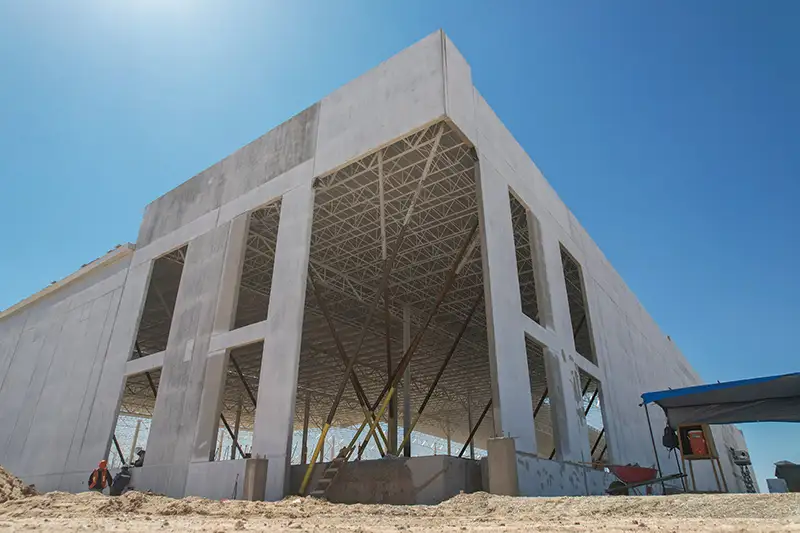 Use tilt-wall when: your building is roughly 20,000 square feet or larger, the site is level with staging room, you want strong wind and fire resistance, and schedule matters. It shines for warehouses, distribution, manufacturing, and large retail.
Reconsider tilt-wall when: the building is small, the site is cramped with no room for casting beds, or you need extensive ground-floor glass and complex geometry. In those cases, a metal building or conventional structure may price better. A good design-build partner will tell you this before you spend money, not after.
How to Structure a Tilt-Wall Budget So Nothing Surprises You
A defensible tilt-wall budget is built in layers, not as a single per-foot guess. Separating the costs is how you spot a number that is too good to be true before you sign anything.
- Hard costs. The physical building and site work: foundation, panels, steel, roof, MEP, paving, and detention. This is the bulk of your spend.
- Soft costs. Design, engineering, geotechnical reports, permits, surveys, and inspections. These are easy to forget and routinely run a meaningful percentage of the total.
- Contingency. A reserve of 5 to 10 percent for the unknowns every project uncovers, from rock in the soil to a utility that is not where the plans said it was.
- Owner costs. Furniture, racking, equipment, and technology that fall outside the construction contract but still hit your capital plan.
When a bid looks dramatically lower than the others, it is usually because one of these layers is missing. A complete estimate shows you all four, which is the difference between a price and a guess.
Why Choose GRA-Gulf Coast Construction
Experience. GRA-Gulf Coast Construction has delivered turnkey industrial and commercial projects across Houston since 1998, including tilt-wall facilities of every scale. That history means our estimates reflect what buildings actually cost here, not a generic index.
Reliability. Our repeat-client rate is built on hitting the numbers and dates we commit to. Disciplined project management keeps the schedule and the budget aligned from day one.
Quality and process. We assemble a project team specific to your build, covering estimating, design-build, field supervision, and compliance, so cost certainty is engineered into the plan rather than hoped for.
Service area. We build across the greater Houston and Gulf Coast region, from Katy and the Energy Corridor to Pasadena and the port submarkets, with local knowledge of soils, drainage rules, and permitting in each jurisdiction.
Frequently Asked Questions
Is tilt-wall cheaper than a metal building in Houston?
It depends on size. Metal buildings often win on smaller, simpler structures, while tilt-wall becomes more cost competitive and more durable as square footage and clear height increase. The right answer comes from pricing both against your specific program.
How much does the site work add to a tilt-wall project?
In Houston, site work including grading, soil prep, paving, and stormwater detention can add several dollars per square foot and occasionally rivals the building cost on difficult lots. It must be priced as part of the total, never assumed.
How long does a tilt-wall building take to build?
A typical tilt-wall shell can be erected in weeks once the slab is cured, which is one of the method’s biggest advantages. Total project time depends on design, permitting, and interior fit-out rather than the panels themselves.
Can I get a fixed price before design is finished?
You can get a reliable budget range early and tighten it as design progresses. Pricing alongside design through preconstruction estimating gives you cost certainty before you commit, which is the safest way to protect your pro forma.
Get a Real Number for Your Building
Online ranges are a starting point, not a budget. The only way to know what your tilt-wall project costs is a line-item estimate built around your site, your program, and Houston’s requirements. Contact GRA-Gulf Coast Construction to price your build with a team that has been delivering Gulf Coast facilities since 1998.